Friday, December 06, 2013

Philately - 1953 - The year of the railways

5 Commemorative stamps were Issued in 1953. One to commemorate the Centenary of the Indian railways, two for the Centenary of Indian telegraph and two to commemorate the successful conquest of Mount Everest.
This Railway centenary stamp, has been a part of my collection ever since I remember collection stamps. Not really sure who gave it to me but I did dearly treasure it.  The stamp was 2anna black and white issue


A bright violet and a brown stamp, commemorate the ascent of man on Mount Everest.


Blue-green and a blue stamp were released commemorating 100 years of Indian Telegraph.  60 Years later on 15 July2013 Ashwani Mishra sent the last telegram to Rahul Gandhi. Just like this stamp the 163 year old Indian telegraphs, passed into history this day. Like I have said before, philately gives one the satisfaction of treasuring this small part of Indian history.


Wednesday, December 04, 2013

Philately 1952- A poetic Year.

In 1952, the post office released six stamps. All stamps depicted Indian saints and poets.
In bright emerald-green, costing 9p was the poet Kabir.


Tulsidas, considered as the reincarnation of Valmiki and the author of Ramcharitamanas, cost 1anna and coloured caramine.By choosing to write the story of Ram in Awadhi, a dialect of Hindi, Tulsidas made the holy book accessible to the common people thus breaking the hegemony of the Brahmins.


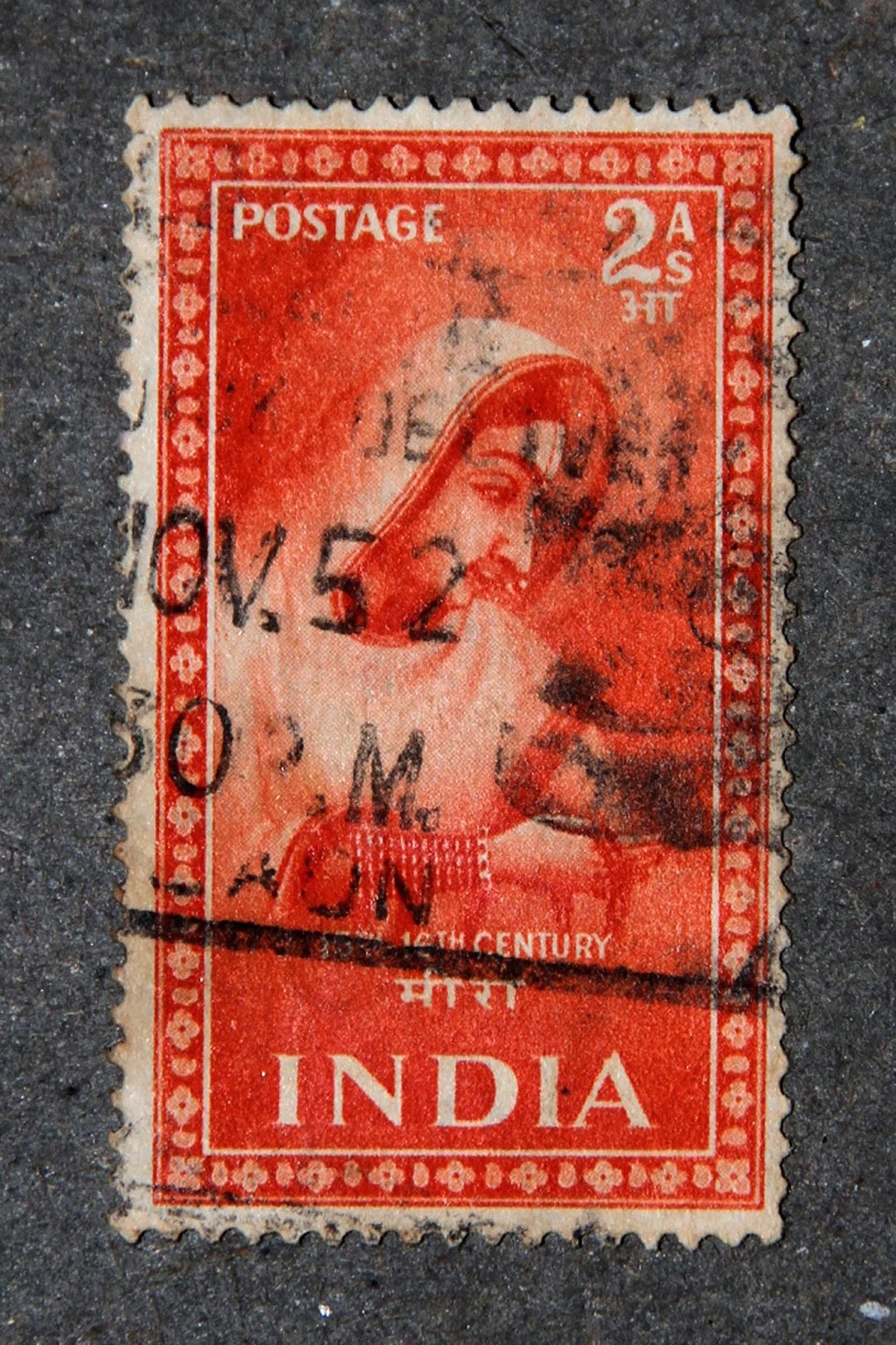
Meera bai, from the 16th Century, was probably was the forerunner of women's liberation movement. She fearlessly broke with tradition and resisted feminine stereotypes, Meera is also an enduring symbol of a liberated woman who risked all to protect her independence, freedom and happiness. The stamp was orange red and cost 2 anna


Surdas, costing 4annas was coloured bright blue. Surdas was a blind singer and is said to have composed over 1,00,000 songs, though only about 8000 exist today.


The first four poets are considered the most prominent figures of the Bhakti movement. It upheld a path to salvation through a personal relationship of love, devotion and surrender to, usually, a particular deity. This form of religion could be practiced by anyone, irrespective of sex or caste.

4.5anna, Ghalib was coloured bright mauve. During the anti-British Rebellion in Delhi on 5 October 1857, three weeks after the British troops had entered through Kashmiri Gate (Delhi, some soldiers climbed into Ghalib's neighbourhood and hauled him off to Colonel Burn for questioning.He appeared in front of the colonel wearing a Central Asian Turkic style headdress. The colonel, bemused at his appearance, inquired in broken Urdu, "Well? You Muslim?", to which Ghalib replied, "Half?" The colonel asked, "What does that mean?" In response, Ghalib said, "I drink wine, but I don't eat pork."

The most expensive of the lot was Rabindranath Tagore in Brown and costing 12 a. ( Today a mint stamp will cost anything upwards of 2000 Rs- A compounded annual return of 14%!!)


The value of these stamps can double, if you can find a pair. 

Monday, December 02, 2013

Philately- 1951, Play the game, in the spirit of the game.

Three stamps were released this year, and delightedly I have all three of them.

The first one was released on 13th Jan and commemorated the centenary of Geological Survey of India. The Black and claret, 2 anna stamp depict two Extinct Stegodon ganesa, a first ever reconstruction of a pre-historic creature on a stamp.
In 1928 century 3 metre long fossil tusk of an elephantine mammal Stegedon ganesa found in India by Dr. Darashaw Nosherwan Wadia. In 1984 the postal department released a stamp commemorating Dr Wadia's contributions to Indian geology and in 2001 another stamp was released to commemorate the 150 years of Geological survey of India.

The two other stamps released were for the First Asian Games, which were held in New Delhi. It must have been quite an amazing feat to do, considering that the country was still dealing with the after effects of partition and the decision to hold the games in New Delhi was done just three years earlier. For a young nation, it was truly a event to be proud of.


Saturday, November 30, 2013

Philately- 1950, India becomes a Republic.

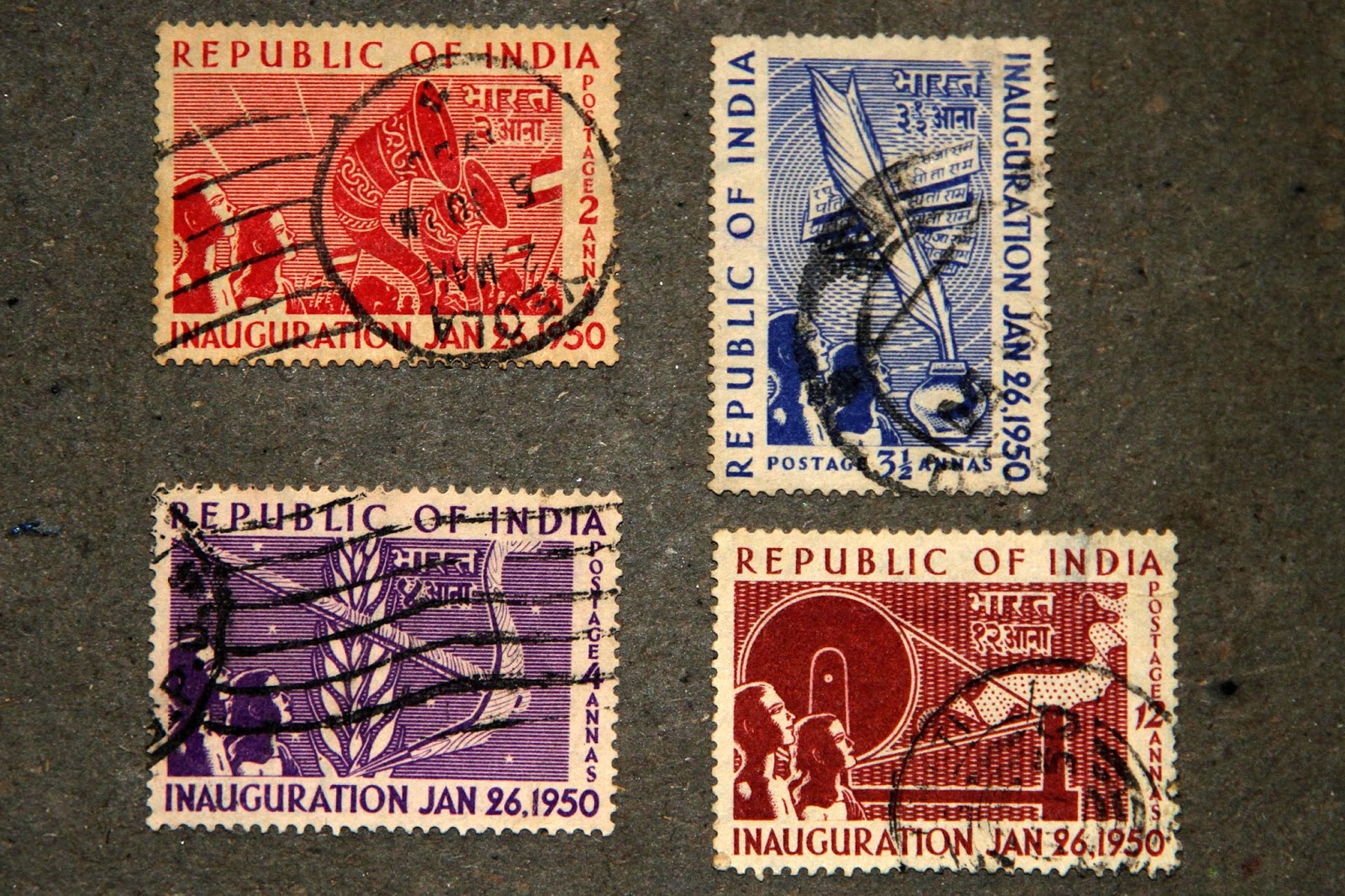
1950 is a landmark year for India. This is the year, when India adopted its constitution and what a constitution it has been. It has been very successful in keeping a diverse nation united and managed to prove all pessimistic pundits wrong. In commemoration of the coming in-force of the constitution, 4 stamps were released. These were the only commemorative stamps that were released that year.


A 2 anna, scarlet coloured stamp depicting rejoicing crowds. Two children are seen viewing a procession of cavaliers carrying flags and blowing trumpets which herald India’s attainment of full Nationhood.
A 3.5 anna Ultramarine stamp depicting Quill, Ink-well and verse. The background shows Mahatma Gandhiji’s favourite hymn “Raghupati Raghav Raja Ram.”, symbolize Nation’s Education.
A 4 anna Violet stamp with a ear of corn and a plough
The 4th stamp was a maroon 12 anna Spinning-wheel and cloth.
The stamps were designed by the British ad agency D.J. Keymer & Co. This is the same company that Satyajit Ray first worked for. Coincidentally, it was this year (1950), that Ray was sent to England by the company, where watching about a 100 movies in six months Ray got motivated to be a film-maker. 

Thursday, November 28, 2013

Philately - Year 1949. an archeological expedition

In the year 1949, 4 Commemorative stamps were released. I do not have any of the 4 and my hunt is on for them. However, 16 definitive stamps were released that year and and 3 more in 1951, making it a total of 19 definitive stamps. At this point, before I proceed, I own you an explanation of what is Commemorative and definitive.

A definitive is a stamp that is a part of a regular issue of a country's stamp available for sale by the postal service for an extended period of time. Hence these 19 stamps were available until 1955 at least. They are also called 'regular issues'

Commemorative on the other hand are issued to honour a person, place, heritage of the nation or an event and available for a limited time. Both the 'Definitive' and Commemorative stamps have postal validity.

Now these 19 stamps issued are together clubbed together as 1st Series of definitives. They are also called the Archeological series, since they feature historic monuments.

I have 17 of the 19 and the monuments represented are.


From top left to bottom right, the stamps are.

Elephant Motif from 'ajanta caves'.
The Horse from Sun temple of Konark.
Trimurti from elephanta caves. Though this one is reduced to the size of a small stamp, the original is about 20 feet in height.
Bodhisattva . There are two stamps, which are mirror image of each other. The second is the correct posture of the image.
Nataraja from Thiruvelangadu.
Mahahbodhi temple (Bod gaya)
Eastern gate of sanchi stupa.
Lingaraj Temple , Bhuvaneshwar. In 2 colours; Lake and Bright blue.


Tomb of Md. Adil Shah ( Also called Gol Gumbaz in Bijapur)
Kandarya Mahadeva Temple in Khajuraho.
Golden Temple in Amritsar
Victory tower in Chittorgarh
Red Fort  in Delhi
Taj Mahal in Agra

The two that I do not have are;
Qutab Minar
Satrunjaya Temple.

These stamps replaced the existing issues of King George VI series, which were still valid and commonly used even after Independence until their stock were exhausted.
P.S. Apologies for the badly arranged stamps on the photographs. They are not mounted, but I placed them from my stock album to photograph.

Tuesday, November 26, 2013

Philately- 1948, The year of the Mahatma

If 1947 was a year to cheer, then 1948 was the year to mourn. Mahatma Gandhi, was murdered by a nut-head. Hence on 15 August 1948, on the first anniversary of Independence, the postal department released 4 mourning issues of the Mahatma.
A total of 5 stamps were released n 1948, other than the 4 mentioned above, on 29th May 1948 a Stamp featuring a Lockheed Constellation aircraft was released. This stamp was meant for one day use only i.e. for the first flight of India-U.K. on 8th June 1948. A total of 0.57 million of these were printed and the once that have cancellation, are quite treasured by stamp collectors and history buffs. Being a small collector, I have only managed to get an un-cancelled issue, nevertheless its quite a treasure for me.

On 15 August 1948, 4 stamps featuring the Mahatma were released as mentioned above. They were printed by Courvoisier, La Chaux de Fonds, Switzerland. Today these are the most treasured stamps of any collector. These 4 stamps in any condition can cost between 10,000 to 20,000 Rs. If they have the words 'specimen' overprinted on them then the cost is not less than 5 lakhs. These stamps prepared by the Indian embassy in Switzerland were mounted on a golden foil and presented in a black velvet folder.

The first is a 1.5 anna Brown stamp, 25 million of these were printed. This is the most common of the 4 stamps.

These 3.5 anna Violet is quite a pretty shade and 2.5 million of these were printed.

3.75 million of these 12 anna Grey-green stamps were printed.

Now for the most soth after stamp, the jewel of a philately collection, the apple of my stamp collection. Since  it was a 10 Rs stamp, the sky high cost of the stamp automatically put it out of reach of most Indians.

The stamp had the words 'bapu' printed in hindi and urdu as a symbol of communal harmony. The stamp created a bit of controversy anyway, since bapu was not shown in his customary dhoti.
100 such stamps had the words 'SERVICE' overprinted on them. These became the worlds least printed stamps. They were meant for the use of C Rajagopalachari, the governer general of India. Today it is estimated that only 18 such stamps exist in the world.
On 5th Ocotober 2007 it was auctioned for 38,000 Euros and on May 19th 2011 re-auctioned and sold for a world record price of 1,44,000 Euros making it the most expensive modern stamp.
Unfortunately my collection does not have the 'Service' overprints, but at least, I feel good to own the 10 Rs Gandhi stamp.
Any of you, who collected stamps in childhood, or acquired a collection or know any one who has a collection of stamp- do keep a look out for the precious 1948 Gandhi's .

Sunday, November 24, 2013

Philately - India after Independence - 1947

When India won her Independence, the Indian government had to deal with a lot of problems; Starting with the refugees, to handling peoples mails. The postal system was already in place, the stamps though had to be designed and printed by the Indian Government.
The tri-coloured Indian flag, featured on Independent India's first stamp. It was printed on 21 Nov. 1947 at Indian Security Press in Nasik. It features the words "Jai Hind" and cost 3.5 annas. This was the cost of an International mail.

The next stamp features the Ashoka capital and cost 1.5 annas. That was the cost of a local mail and 22.7 million of these were printed. Guess people wrote a lot those days, considering the poor rate of literacy.
The next two stamps were printed in Dec 1947, and are thus the second stamps of Independent India.


The final stamp released that year cost a whopping 12 annas. It was meant for International mail sent via air. Hence it aptly features a Douglas DC-4. Despite the cost, 2.4 million of these were printed.


Though I mostly collect cancelled stamps, i.e. stamps that have been used in postage, at some stage of their life- Being the first 3 stamps of India, I was truly delighted when I came across three un-cancelled stamps and decided to make them an exception. 

Friday, November 22, 2013

Philately - The Monarchs.

It is called the 'Hobby of the Kings', but today it appears to be following the kings- Philately, which is a fancy name for stamp collection, happens to be a hobby which I picked up during my childhood and has stuck with me all these years. Philately is not only a window to history, it is also a very easy and inexpensive way (most of the times) to keep with you a part of that history.  In the coming days, I will share with you my small little collection of stamps and post some of the interesting things that I have learnt from these small bits of papers. I will endeavor to take the jargon out of philately and get some much needed factoids into it. I will only showcase the stamps that I have and since I collect only stamps of India, it will only be Indian stamps. Both prior Independence (15th August 1947) and after India won her freedom.
So lets start with a small post on stamps of the pre-Independence days. The stamps of  British India period, feature the profile portrait of the ruling  monarch. Four Monarchs feature on Indian stamps- any idea who they are?


From 1st October 1854 ( the day the first stamp was released in India) to 1902 ; the stamps carried the profile of Her Majesty Queen Victoria. She is the only Queen, to feature on British India stamps and so is quite easy to identify.
This first stamp, which reads "East India Postage" was released prior to 1882, after this year, the British crown took over from East India Company ( because of the Sipoy Mutiny or first war of Indian Independence).


From 1901 to 1910 it was King Edward VII.  He is shown with receding hair and appears without a crown. 


From 1910 to 1936 it was King George V. He appears with a crown and has a well kept beard.


From 1937 Until Independence it was King George VI. He too appears with the crown but has a clean shave.
So I hope after reading todays post, you will be able to identify a monarch with a glance at the stamp and approximate the time period. Hoping you will all enjoy this fascinating window into Indian History.


Wednesday, November 20, 2013

'As blind as a bat'

Is a bat blind and needs echolocation like how we are taught? 
Nope, bats aren't blind at all!! There are about 1,100 species of bats in the world and not one is sightless. The fact that bats are blind and use echolocation or 'sonar' is completely bunkum. Fruit bats don't use echolocation at all. Their favourite food (yes, you guessed it right- Fruit) does not move much and they use their colour vision and keen sense of smell to locate it. For navigation, they use their large eyes. The Common vampire bat (Desmodus rotundus) is the only bat that feeds on mammal blood; it has a vision that can rival our night vision devices. It can see a cow 120 meters away; in pitch darkness (try beating that). Microbats that eat insects do use echolocation to hunt.However for all other purposes (avoiding obstacles, spotting landmarks or calculating flying height) they use their eyes. Unlike Fruit bats though, microbats see in black and white. There are fish eating bats too, like the Greater Bulldog bat (Noctilio leporinus), which again uses its keen vision and big feet to scoop out fish from water. Lots of bats around your home means a lots
of less mosquitoes to deal with, because one hungry bat can munch up to 200 mosquitoes per night. Burrp!

Saturday, November 16, 2013

A chemistry of two leaves.

My wife and I were visiting a nursery when we came across an amazing plant. The nursery lady, told us that it was called “Basmati grass.” When crushed the leaves smell like basmati rice, and if you add it to rice when cooking, even ordinary rice can have the aroma of basmati rice. After a bit of research, I have learnt that the shrub belongs to the lily family and is native to Indonesia. It is called the ‘Screwpine’ or Pandan. The strap like leaves have the same volatile compound that gives basmati rice its distinct, nutty, aroma; 2-acetyl-1-pyrroline (also contributes to the aroma of crabmeat and popcorn).  

Seasoning of Indian curries is incomplete without the all important ‘curry leaves’ The curry leaf plant, ‘Murraya koenigii’ belongs to the citrus family. The leaves have subtle, woody fresh notes and are either simmered or briefly sautéed in cooking oil. These leaves contain a remarkable alkaloid called ‘carbazole’ – which is not only an antioxidant but also has anti-inflammatory properties. This molecule is also used as a precursor for anti-HIV, anti-cancer, antibacterial and anti-fungal drugs. 

Thursday, November 14, 2013

Antimony Facts.

Nebuchadnezzar, of hanging gardens of Babylon fame, painted his palace yellow by using an Antimony- lead mix. Soon he went mad, sleeping outdoors in fields and eating grass like an Ox. Around that time Egyptian women, used antimony as mascara to decorate their faces. During medieval times, alchemist – not to mention Isaac Newton- grew obsessed with the sexual properties of Antimony. Some insisted that Antimony was the essence of femininity- so much so that the alchemical symbol of antimony became the general symbol for “Female.”
Antimony was also used as a laxative. Unlike modern laxatives antimony pills didn’t dissolve in the intestines, and the pills were considered so valuable that people rummaged through faecal matter to retrieve the pills. In some families the antimony pills were also passed down as family laxative heirloom.
In the 1930’s in China, a poor province decided to make money from antimony, since it was the most abundantly available resource there. But antimony coins are soft, easily rubbed away and toxic, all properties of bad money. The government soon withdrew the coins. Though worth just fractions of a cent then, these coins fetch thousands of dollars from collectors today.
Mozart is supposed to have died by taking too much antimony to combat a severe fever.
Today Antimony is used to make custom built acids. Antimony pentafluoride, (SbF5), with hydrofluoric acid (HF), produces an acid with a pH of -31. This acid is 100,000 billion billion billion times stronger than stomach acid (pH 1) and will eat through glass, and dissolve the hand that holds the glass too. (It is stored in special Teflon lined containers)

Ah! This reminds me, although unrelated to the topic. Prior to 1890, scientists judged acids and bases by tasting or dunking their fingers in them.

Tuesday, November 12, 2013

Tasting time

Today if you want to check the time at the middle of the night, you either have a backlit watch or may be a talking clock. Well back in the seventeenth century, when neither of that existed, M. de Villayer, a French inventor, tried using the sense of taste.

He designed a clock so arranged that when he reached for the hour hand at night, it guided him to a small container with a spice inserted in place of numbers, a different spice for every hour of the night. Even when he could not see the clock, he could always taste the time. 

Wednesday, November 06, 2013

Bycatch- An ecological nightmare.

When massive trawlers spread their nets, to catch those tasty shrimps or fish and haul them onboard they haul much more than shrimps. In fishing industry it is called a “bycatch”. An average shrimp-trawling operation throws 80 to 90 percent of the sea animals it captures overboard, dead or dying as bycatch. Shrimps account for only 2% of global seafood by weight, but shrimp trawling accounts for 33% of global bycatch. Most of us are unaware about this, since there exists no bycatch label on our sea food. How would you feel, if the shrimp you buy had this tag on it “13 KILOGRAMS OF OTHER SEA ANIMALS WERE KILLED AND TOSSED BACK INTO THE OCEAN FOR EVERY HALF KILO OF THIS SHRIMP”
While catching fish like tuna, among the other 145 species regularly caught the following endangered species meet their end. manta ray, devil ray, spotted skate, bignose shark, copper shark, Galapagos shark, sandbar shark, night shark, sand tiger shark, (great) white shark, hammerhead shark, spurdog fish, Cuban dogfish, bigeye thresher, mako, blue shark, wahoo, sailfish, bonito, longbill spearfish, lancet fish, grey triggerfish, needlefish, blue runner, black ruff, dolphin fish, bigeye cigarfish, porcupine fish, rainbow runner, common sea horse, Bermuda chub, opah, escolar, leerfish, tripletail, goosefish, monkfish, sunfish, Murray eel, pilotfish, black gemfish, bluefish, cassava fish, red drum, greater amberjack, yellowtail, common sea bream, puffer fish, loggerhead turtle, green turtle, leatherback turtle, hawksbill turtle, Kemp’s ridley turtle, Atlantic yellow-nosed albatross, Audouin’s gull, balearic shearwater, black-browed albatross, great black-backed gull, great shearwater, great-winged petrel, grey petrel, northern royal albatross, shy albatross, sooty shearwater, southern fulmar, Yelkouan shearwater, minke whale, sei whale, fin whale, common dolphin, northern right whale, pilot whale, humpback whale, beaked whale, killer whale, harbor porpoise, sperm whale, striped dolphin, Atlantic spotted dolphin, spinner dolphin, bottlenose dolphin, and goose-beaked whale.

So imagine, you have a plate of sushi. Now imagine this plate also holds all the animals that were killed for your sushi. That plate then would have to be 5 feet across to accommodate all the bycatch.

Monday, November 04, 2013

What colour are carrots?

Orange you say..? Well for 5,000 years, carrots have been anything but orange. The earliest use of carrots by humans are found in archeological sites in Afghanistan, those were purple in the outside and yellow inside. Next in line are the ancient Greeks who cultivated carrots for medicinal purposes and Roman physicians in
the 2nd century prescribed it for expelling wind. The Arab traders carried the carrot seed to Asia and Africa where it blossomed into various shades of purple, white, yellow, red, green and even black carrots. So where did our orange carrots come from? It was grown in 16th century Holland, patriotically bred to match the colour of the Dutch Royal House of Orange! By the 17th century, the Dutch were the main European producers of carrots and all modern varieties are descended from their four orange ones; Early Half long, Late Half Long, Scarlet and Long Orange. Well non-orange carrots are making a come back, so the next time you see a white , yellow, dark red or purple carrot, don't run away from it, they are natures natural breeds. Anyone for a ' Tiranga gajar halwa' ?


Saturday, November 02, 2013

What is the capital city of Thailand?

Krung Thep (pronounced Grung Tape). What happened to Bangkok then ! Well Thai's haven't used
the word Bangkok for nearly 200 years now. Only ignorant foreigners and their encyclopedias use it. Bangkok was a small fishing village until King Rama I moved there in 1782 and renamed it 'Krung Thep'. Although Krung Thep is used for all daily purposes its official full name is ' Krungthep Mahanakhon Amorn Rattanakosin Mahintara Yudthaya Mahadilok Pohp Noparat Rajathanee Bureerom Udomrajniwes Mahasatarn Amorn Pimarn Avaltarnsatit Sakatattiya Visanukram Prasit (quite a mouthful this one).
In Thai it's written as a single word with 152 letters. Krung Thep means 'City of Angels' (yes, the same as Los Angeles). Well if you still insist on using the word Bangkok, in Thai it means Village of Plums.(Well for
those curious, the official Thai name roughly translates as; Great city of Angels, the supreme repository of divine jewels, the great land unconquerable, the grand and prominent realm, the royal and delightful capital city full of nine noble gems, the highest royal dwelling and grand palace, the divine shelter and living place of the reincarnated spirits')

Wednesday, October 30, 2013

Anything for science.

One of the biggest hazards of deep sea diving is something called the ‘bends’. The air was breath is 80% nitrogen. Put the human body under pressure, and the nitrogen is transformed into tiny bubbles that migrate into the blood and tissues. If the pressure is changed too rapidly, as with a too quick ascent by a diver; the bubbles trapped within the body begin to fizz like a freshly opened soda bottle, clogging tiny blood vessels and depriving cells of oxygen and causing so excruciating pain that sufferers are prone to bend in agony. A great deal of what we know about surviving at extremes is owed to extraordinary father and son team of John Scott and J.B.S. Haldane. Haldane’s gift to diving was to work the rest intervals necessary to manage an ascent from the depths without getting the bends. With Admiralty funding, JBS acquired a decompression chamber that he called the ‘pressure pot.’ This was a metal cylinder in which three people could sit at a time and could be sealed and subjected to tests of various types. Volunteers were required to sit in ice water while breathing ‘aberrant atmosphere’ or subjected to rapid changes or pressure. In one experiment, Haldane simulated a dangerously hasty ascent and the dental fillings in his teeth exploded. It is said that every experiment ended with someone having seizures, vomiting or bleeding. The chamber was virtually soundproof, so the only way for occupants to signal distress was to tap insistently on the chamber wall or to hold up notes on the small window. Once while poisoning himself with elevated levels of oxygen, Haldane had a fit so severe that he crushed several vertebrae. Collapsed lungs were a routine hazard. Perforated eardrums were quite common. Haldane in one of his essays writes “ the drum generally heals up; and if the hole remains in it, although one is somewhat deaf, on can blow tobacco smoke out of the ear in question, which is a social accomplishment.” It was not just Haldane, but even his colleagues and family were subjects of his experiments. Sent on a simulated descent, his wife had a fit that lasted 13 minutes. When at last she stopped bouncing across the floor, she was helped on her feet and sent home to cook dinner. Haldane happily employed anyone who happened to be around and on one occasion a former prime minister of Spain, Juan Negrin. Dr Negrin complained afterward of minor tingling and ‘curious velvety sensation on the lips’ Dr Negrin was lucky, a similar experiment with oxygen deprivation left Haldane without feeling his buttocks and lower spine for six years.
 

Adapted from Bill Bryson’s “A short history of nearly everything”

Saturday, October 26, 2013

Who has more hair: you or a chimpanzee?

Both chimps and humans have the same number of hair follicles about 5 million. However, the human hair is thinner and more transparent than the hair of other primates.Hence, although we have equal number of hair, the chimps look hairier. We have lost our fur and no one knows why for sure, there are many theories
floating around (and you can cough out your own theory too, no one will mind). But I would like to agree to the one proposed by Darwin, 'Sexual Selection' . Darwin believed that as we humans evolved, our ancestors
chose partners with lesser and lesser hair and the hairy ones finally lost out. We see this even today, where our fascination for that smooth, hairless female skin makes the women spend painful hours waxing in a parlour. Similarly, we men have to spend time everyday in front of the mirror, to satisfy the women's need for clean shaven men. Now again no one knows why men retained facial hair, but for this I have my own theory
(all brickbats for me, not Darwin) I believe, our ancestral women were much more tolerant towards men with facial hair than men were towards women. May be after a day of hunting the woolly mammoth, men wanted to feel something much smoother! The present day women though have lost that tolerance and I am sent right back to the shaving mirror, even if a stub of hair protrudes from my face!

Tuesday, October 22, 2013

Elementary elements.

Top post on IndiBlogger.in, the community of Indian Bloggers
Two of the rarest natural elements on earth are Astatine and Francium. Astatine is so rare, that it is practically unstudied. It has a name and a place on the periodic table, but nothing else. Francium is so rare that it is thought that at any given moment there may be fewer than twenty francium atoms on earth.
Astatine is the only element whose discovery was confirmed by a non-primate. Emilio Segre had identified Astatine in 1939 and injected it into a guinea pig to study it. Because, astatine is below iodine in the periodic table, the body thinks it to be iodine and handles it as such. So in the guinea pig, it was selectively filtered and concentrated by the rodents thyroid gland. Pretty neat trick!

I know the above elements like many other in the periodic table are quite obscure, but that does not mean obscure elements come in trace quantity. Take for example cerium, there is more of it on earth than copper. There is more neodymium and lanthanum than cobalt or nitrogen. Not surprised yet. Praseodymium, samarium, gadolinium and dysprosium are more abundant than tin. 

Sunday, October 20, 2013

Does wearing sunglasses cause anaemia?

Yes it can, and to tell you how it does I need to introduce to you two nutrients. 
1. Folic Acid; it is one of the vitamin in the B complex group. Among it's many functions one very important is the role it plays in manufacture of red blood cells (RBC's are small cell's in your blood that transport oxygen, Anaemia is a fancy name for their deficiency)
2. Vitamin D; Body produces its own vitamin D from cholesterol in the presence of ultraviolet light (UV).
Like you can see, our body needs the UV light for Vitamin D production, but the same UV light is quite deadly for Folic acid and can destroy it. So the body has to hit a balance between the UV light it receives, not too much not too less. To maintain this balance it pulls a pretty neat trick. 
Introducing Melanin; Melanin is a pigment that gives our skin its colour, most importantly it is body's natural sunscreen, blocking the UV rays. The amount of Melanin is controlled by the boss of all glands,the Pituitary. Whenever you are exposed to sunlight, the Pituitary gland goes into an overdrive, cranking up melanin production to protect the body's Folic Acid reserves. When you come into a shady area, it reduces melanin production to keep Vitamin D manufacture unaffected (which needs UV). So how does the pituitary, which is located in a dark corner of the brain, know whether there is sunshine or not? It has its own spy-cam,
your eyes. When sunlight falls on the optic nerve, it triggers the pituitary to produce melanin or reduce it when there is no sunlight. So when you wear those fancy sunglasses and walk in sunlight, your pituitary thinks
that you are still in the shade. Melanin production is still at the shade levels. However, the UV light is now destroying your Folic acid en masse. Over a period, your Folic acid reserves deplete, which leads to a fall
in RBC production leading to anaemia. Phew! So next time you think you have anaemia, and pop in that iron supplement, try popping out those Ray-Ban's. Your doctor never told you this did he/she?

Friday, October 18, 2013

What's wrong with my cotton shirt ?

Top post on IndiBlogger.in, the community of Indian Bloggers
For all its virtues, cotton is the preferred choice of material for most of our clothing. I even purchased a few shirts, which had a label proudly displaying “100% Organic Cotton.” Similarly, it feels good when I know; that the paper I use has “XX% recycled fibre in it.” Despite all these feel good labels, it’s a marketing gimmick after all. By trumpeting the narrow virtues of the product, we easily miss the big picture and miss the numerous negative impacts of our purchase. My Cotton shirt was indeed organic, the farmer who grew the cotton, did not use pesticide on his crop. Cotton crop alone accounts for 10% of the worlds pesticide. The organophosphates (which cause central nervous system damage in humans) that they spray, to control bugs and weeds, ends up in streams and rivers. Given this damage, the benefits of Organic cotton are indeed laudable. Then there is the downside. Cotton is a very thirsty crop; it took about 2.5 tonnes of water to make the cotton for my shirt. The shirts I purchased had various hues. Cotton yarn is bleached, dyed and finished with industrial chemicals that include chromium, chlorine and formaldehyde, each a toxin in its own sense. Cotton, resists absorbing dye, so when a dyed yarn is rinsed, a large amount rinses into the factory wastewater, which is pumped into our local rivers. These dyes harbour carcinogens- hence workers in dye plants have unusually high rates of leukaemia. Similarly, various products make claims on being healthy or environmentally friendly based on a single attribute (fried snacks do not become healthy just because they have zero transfat or no cholesterol). Indeed nothing made industrially can be utterly green or healthy only relatively so. When my wife explained to me on how a drug discovery is made, I realised the immense amount of research that goes into such a find. The care taken to learn about the impact of the molecule on humans, its metabolism in the body and the time taken for it to be eliminated from our system is truly commendable. However, how much research actually goes into studying what happens to the eliminated molecule. These chemicals once eliminated do not just disappear. Take for example all those tiny doses of synthetic estrogens, found in birth control pills. Even though the human body excretes these estrogen compounds in the form of a metabolite, bacteria in sewage cleave the molecule and recreate the original compound. This estrogen, is known to “feminise” male fish (male fish stop making sperm and instead produce eggs). Similarly any of us who take antibiotics or use antibiotic soap add, it to the 11,000 tons of antibiotics used annually by animal farms.

To know our shopping impact, I recommend the site www.goodguide.com. Though mostly focused on US and European products, we will find many products we used in India reviewed. Use it in making an informed purchase, make a difference to your health and environment.